Part 1: Where
When I taught, there was an administrator that would always say, “If you fail to plan, you plan to fail.” I later learned it was a quote from Benjamin Franklin. I would always glance around after hearing it. Who, I thought, is he talking to? How could one teach without a lesson plan?
I am a planner. A big planner. If fact, if I don’t plan, I feel so out of sorts. And when it came to teaching in my early years, I spent hours each week perfecting my lessons. Of course as I gained experience, it would take me a lot less time. But to meet a person who could teach without a plan, I wanted to shake their hand. I never could do it.
When it comes to planning, gardening is much like teaching. If you have ever had a garden, you planned. You had to. Maybe not on paper, but you planned out how many plants you needed, where they would go, how you would take care of them, among other things. The better you plan, the better your garden will be.
I have created a four part series on garden planning. Yes, four parts, because it is that important. So let’s get to it.
This is the first of four parts.
Where
First, figure out the site location of your garden. Maybe you are starting from scratch. Maybe there were established beds when you moved in. Maybe it’s in containers. Maybe it’s in both containers and the garden bed. However you garden, make sure it’s best for what you want to grow. The following focuses on growing in garden beds, but can be applied to containers.
Sunlight
The rule of thumb is to make sure your bed gets at least 6 hours of direct sun. This is considered full sun. On a day you already planned to spend at home, set an alarm to go off once an hour as soon as the sun is up. Look at the spot your garden is or will be and jot down if it gets full sun that hour. I believe it is best for a garden to never be shaded any part of the day, but rather create shade with taller plants like tomatoes. If your garden or a portion of it gets part shade, consider growing leafy vegetables there like lettuce. Plants that fruit, such as tomatoes and peppers, need full sun.
Water
It may go without saying but a successful, healthy garden needs a constant supply of water. In South Carolina, it doesn’t rain often enough to let nature do its thing. You must plan ahead. It’s smart to place your garden close to a water source. There are several options for watering.
- hand water
- sprinkler
- soaker hose
- dripline
Lets take a quick look at their advantages and disadvantages.
Hand watering- It’s the cheapest method. You can use a watering can or a nozzle on a hose. The down side is that you have to remember to do it and then do it. It also puts extra, unnecessary moisture on the leaves, which could lead to diseases.
Sprinkler-You don’t have to stand in the heat to water but rather let the sprinkler do it for you. If you have it hooked up to a timer, you don’t even have to remember to do it. This method, though, also put extra moisture on the plants. It wastes a lot of water and it also puts water where you may not want it, on weeds.
Soaker hose– These are a great choice. It puts the water right where you want it, at the roots of the plants, keeping it off the leaves. You can also have it on timer. I’ve never used one, but I have heard they don’t last too many seasons. But they are a cheaper choice and sold everywhere.
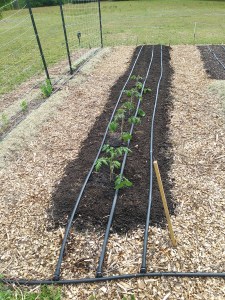
Dripline– This option is by far my favorite and what I use in my garden beds, even my flower beds. They use little water and put it right where you want it. It can be put on a timer so you don’t have to think twice about it. You can buy them in kits from reputable companies but they are an investment. My kit came with a filter so I can rest assured that chlorine isn’t killing the microbes in my soil. You could leave them in the garden over winter, but I pull mine every fall which means they have to be stored.
Wind
Wind can be a problem for your garden depending on how much or little you get. Wind helps pollinate but too much can be damaging. It can knock over plants and dry them out. If your garden is between two close buildings, there may be more wind than if it was in a open field. This past year, in late winter, strong winds that lasted a couple days pulled out my broccoli plants that were just beginning to grow the broccoli head. I was so sad but it could have been prevented by protecting them with row covers. Now you get to learn from my mistake, so not all is lost!
Soil
The soil in which you plant your garden is the most important factor when it comes to your success. I could spend 10 or 20 posts talking just on the topic of soil. I’ll keep it short for now. You have to know what you have when dealing with your soil. Questions to consider:
- What is your soil’s pH?
- Is it lacking any nutrients?
- What type of soil do you have? Sand, silt, clay?
- Does it flood or drain well?
- What is its structure like?
- Does it have enough organic matter?
If you don’t know these answers, its best to get a soil test. Though not all, it can answer many of those questions. A standard soil test tells you your soil’s pH, some nutrient content, and its cation exchange capacity (CEC-a measure of the fertility and productivity).
When is the best time to do a soil test? In the fall so that if you have to change the pH, you have months to do so before your spring garden. Why does pH matter? Because if it is too low or too high, it can tie up nutrients so they aren’t available to plant roots.
Can’t I just add an all-purpose fertilizer and call it quits? Well yes, but truthfully you don’t know what it is lacking to know how much to put into the soil. Putting too much or too little can cause the plant to not grow properly and possibly not even produce fruit.
Sounds complicated, right? Don’t worry, it’s not as difficult to test as you might think and once you get the hang of it and do your part, your plants will thank you by producing the best flowers, fruits, and vegetables they can. In Marlboro County, where I live, it is about $6 to get a standard soil test from the Clemson Extension office. They send you an e-mail with the result and give you suggestions on how to amend your soil based on which crop you said you were growing. There is also a number for you to call if you should have any questions. You can pick-up a form from the extension office or download this one. This link is helps you fill out the form. Here is a link on how to take a soil sample. I have heard it recommended to get one every 3 years for home gardeners, but if you are able, I suggest to get one every year.
 Blooms for Life Farm
Thank you. Do you need any volunteer work so I can learn from you?
LikeLike
Hi Lindy. I teach classes at the Marlboro Extension Office. No need to be a resident of Marlboro County to attend. Check the Blooms for Life Facebook page or the Marlboro County 4-H page for information on classes.
LikeLike